This is a piece I wrote at this time last year. Liminal space is the space between, the transition zone between one thing and another. There is always space between the forest and the wetland, a mixture of both where a completely different set of ecological interactions take place. Just as there is a liminal space between us.
Liminal Velocity

Home is the liminal space
Between dream and reality
Like the space between a swamp and a fen
Where the speckled alders and cattails grow together.
A space you occupy
Where we meet in the in between
Of late summer chorus and early mabon fog

The liminal space
That land between the rose garden and the industrial blocks
Where we roam and witness lives
Without really being a part of them
Liminal Velocity
The instant between the story you tell me
and my brain processing the words-
and losing them
in the high of seeing your smile again.

The liminal space
Between having a voice and the
Silence of a lichen
Is not so wide a canyon
As the illusion projected on the screen.
It is a pinch of genetic code, and political gain
Taught by worlds with borders between
Urban and wild
And you and me

Liminal space,
like the sandy shore between my feet and the mantel of the Earth
where things grow and death becomes life
decomposing to a base substance we call dirt.
Soil, a rush of petrichor between the rain and the sun.
blending together with the sound of your laugh
like one essence of laughter and smell,
a dance between sensation.

Liminal Velocity
The space between
my perception of you
and the reality of you-
different forms of the same perception-
is the same as the space between the sea smoke
and the inland sea herself.
The one perception we share.
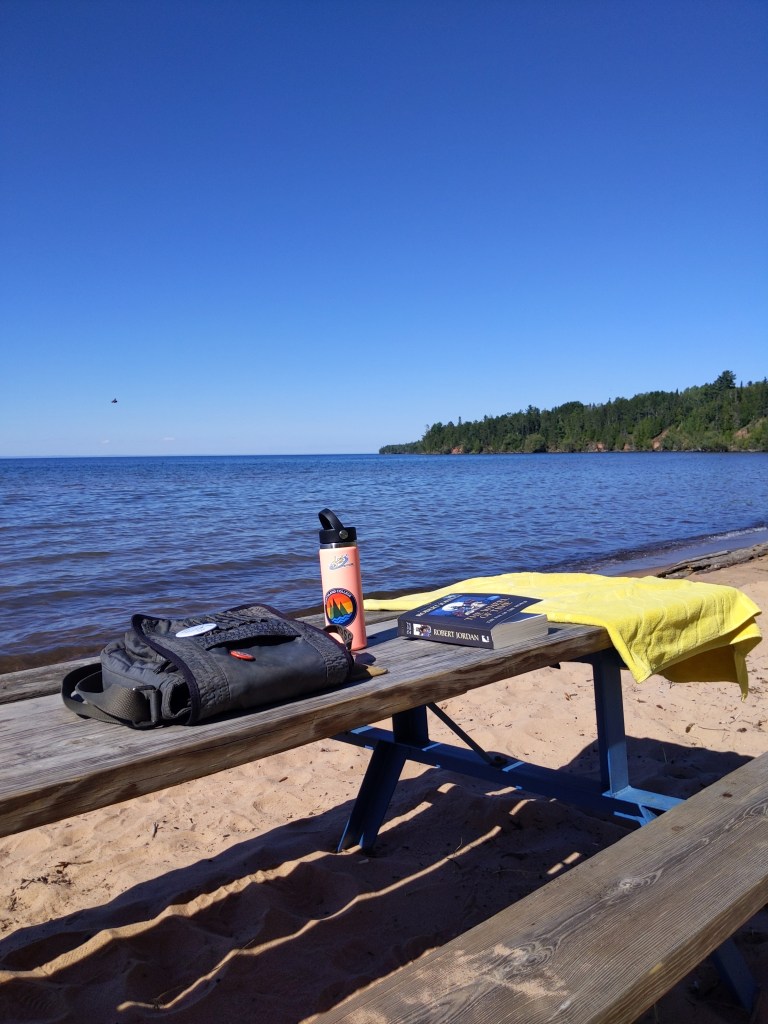
A full year after my mentor, Joe Walewski, gave my cohort of naturalists an assignment I am finally getting a round to actually doing it. It may not end up exactly as he assigned, or even close to that. However I am doing it. Today is my 14th day sitting in the same spot at Corny Beach for at least an hour each day. I have a routine here. Take a picture, sit and watch the waves of Gitchi Gumee and note their intensity (soft, but not still today), read by book (Schools that Heal by ___________), dive into the Lake, then read again as I dry out, switching to my novel (Robert Jordan’s Wheel of Time today). I expect I’ll continue this trend for another week or so until I have to travel for a few days.
Sitting this way, collecting snapshots in time and watching changes every day or week or month is called a sit spot. I don’t know the origin of this practice, someone can hopefully give me a history, but I hope that contemplatively inclined humans have been doing this since the dawn of consciousness. It’s the practice of the Buddha, sitting under the tree and finding enlightenment. It’s the practice of __________. Sometimes we humans are drawn to a place, and we sit there many times in our lives. It’s a practice I have always been pretty bad at until the past two weeks.
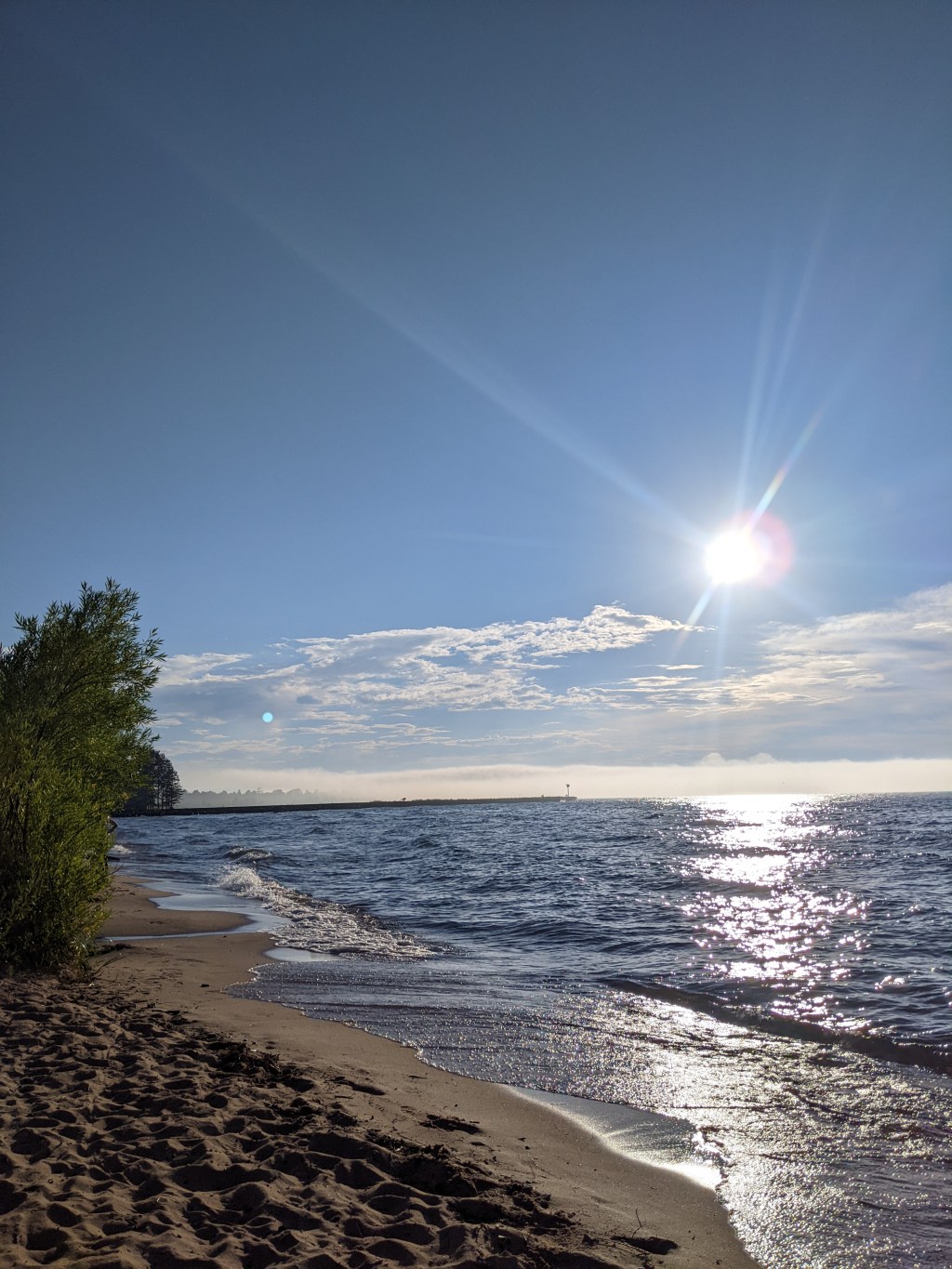
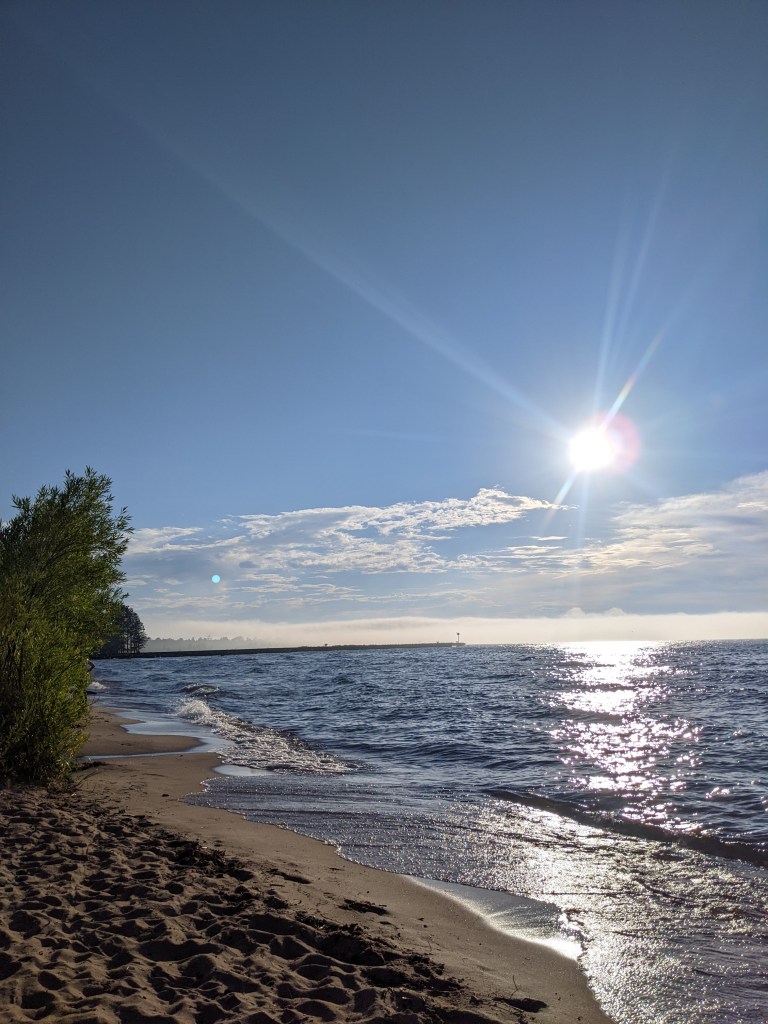
My sit spot at Corny Beach as it is today.
Through sit spots we can see the world shift between weather and seasons, noting who is doing what and when. Here at Corny Beach, I’ve observed how tourists react to the weather and day of the week. There’s the obvious, with there being fewer folks on a blustery wavey weekend than a bright and warm one. But there’s the not so obvious, like there being so few people here on a perfect and sunny Wednesday. Today I noticed a high number of bee flies swarming about, harmless flies which have evolved to appear like the more painful and more bountiful bee. I notice that the way the Lake moves is changing between the summer and the fall, and the ways various levels of siche effect change the structure of the beach. Maybe tomorrow I will notice the smaller plants and animals at my spot. Having a spot, and visiting it everyday, gives me joy in the knowledge of my place. Here I hold space only for me, give myself a chance to become steady, and just breathe. Even living so close to Lake Superior, sometimes in the details of life it becomes easy to forget she’s there. Making these visits part of my life everyday has made it impossible to forget that the Lake is right there, ready to support me.
If you’re like me, a digital native born in a time of stimulation and content, it can be difficult to just sit in the same spot and observe. Don’t try. Please do have those moments of wonder in which the content washes away, but don’t force it. Don’t force your sit spot either. As you begin this practice just walk around, find yourself somewhere. Sit someday, maybe years from now, maybe tomorrow by the swamp or on that bridge you like. Then, as you find that place for the moment, take out your content whether that’s a book or a journal or crocheting, and let your conscious mind focus on that. The rest of your mind will make observations of the world around it, and give you curiosities to follow as you will. And then, the next, find yourself craving to return to the same spot, and go.
Corny Beach Day 1: Fog over Roman’s Point and perfect sunshine just a mile away.
The Lakes Shore we once paddled continues to breathe-
In and Out.
The siche folds its layers over itself in fractal waves
      Like percussion beats.
The beats of your breath, have ceased. Is life
Like a butterfly?
Beating its wings, effecting change
Half a world away.
Is it the change you fought
So hard for in the world. Or is it
Just the incessant beat of the world marching on?
You once told me you were afraid
To imagine the change we marched for-
	       Side by side lifting a banner in the streets of St. Paul.
You lived it and where is it now. Here, Now.
With the Lake and the rainforests of Panama.
	Forever impermanently interwined with reality.

“Where ever you go, there you are.” He once told me.
We had taken such different paths to that same Canadian Beach.
And the waves of Mother Superior went on
With the beating wings of a quail.
We walked together from Hattie Cover to the distant point of rock
And we laughed until the sun set over that glistening Lake.
And we wept.

	The waves continue
	From us to thee
	Forever impermantently intertwined
	While we are apart
	One from the other.
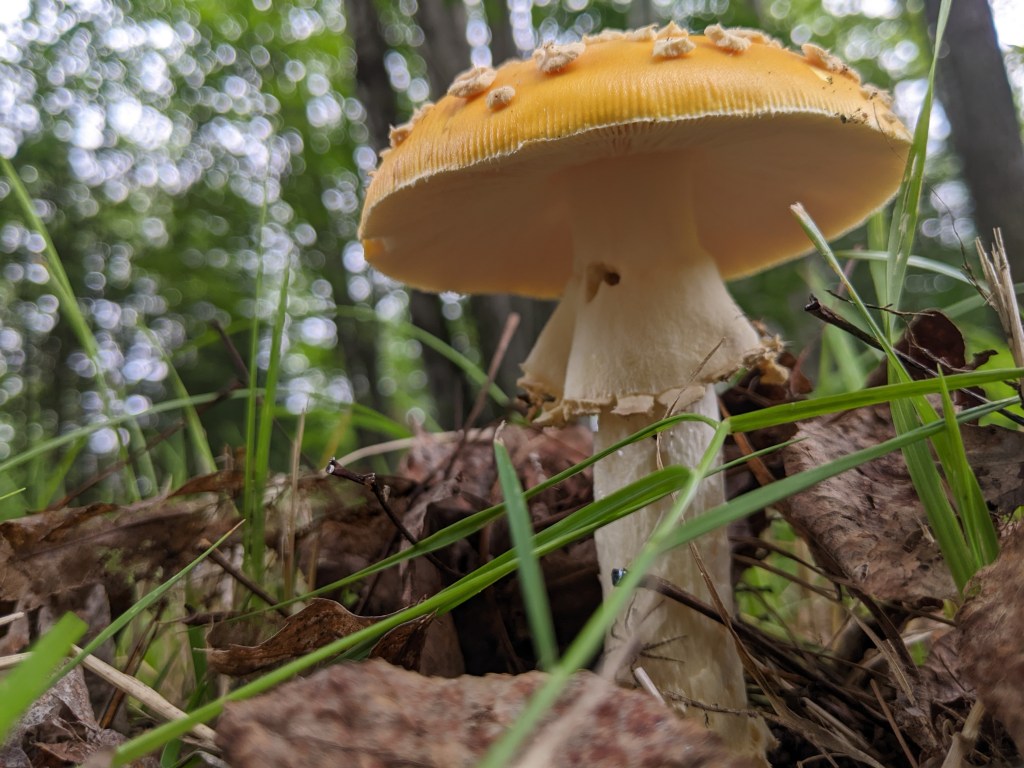
A Frost’s Amanita I found growing on my driveway this morning.
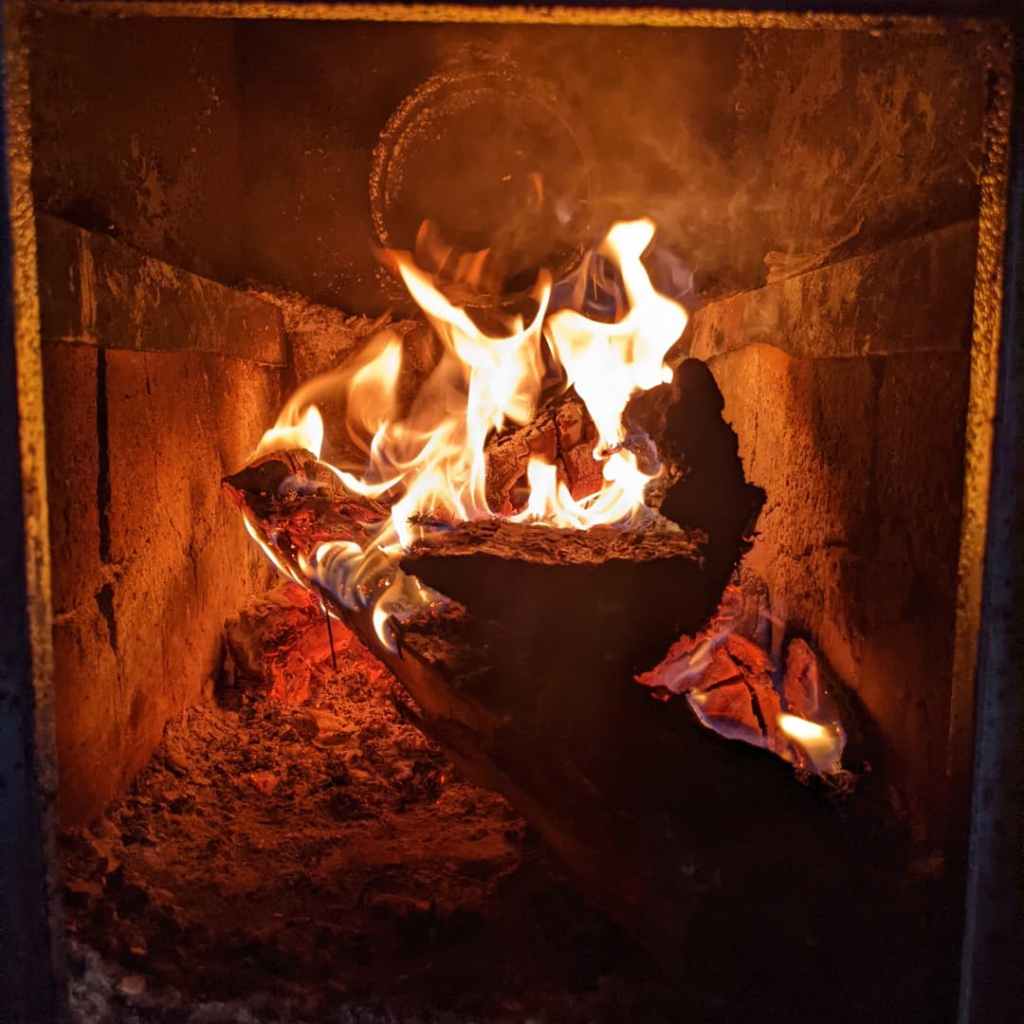
The South Shore is chilly today, with the jet stream pushing cold polar air southward across the Lake. A sublime Autumn chill may hang out with us all week long, as our bodies still crave the celebration of August, time spent sunning on the beach or working in relationship with still growing food. Instead, yesterday I lit my woodstove in the afternoon, retreating inwards toward myself and my fire while I let my cat be fascinated by the mother deer with two fawns, and by the hummingbird who visited my feeder for some rest. Yesterday, I needed to give my curiosity a break to recover it again for the week ahead.
My woodstove gives me the most lovely warmth, while it burns away years of history. Each piece of wood I burn is a record of an individual history, full of years of bounty and years of withering. What did the trees of this fire dream of before now? How did they perceive the world? I sit, I wonder, and I listen to the crackle of the fire as history heats my heart. I’m thinking I will post poetry on Sundays and essays on Wednesdays for now until my big move in November. We’ll see how it goes.
What season is it?? Who knows.
In the flame of the woodstove
Witness the dreams of the universe
As embers weave their way through the air before
Revealing themselves like stars
Just more delicate
Fewer parts of hydrogen to fuel
Your heart.
They are multitude and small
Simple as a hallucination
The one that tells you that you turned off your
Alarm Clock, that morning the sun had not yet peaked through
The window to your naked body.
Your alarm clock still sang
The sound of waves crashing, even though
Those same waves are frozen now.

The same waves that made rainbows in the mists of the sea caves
The same waves where we kissed and first began to dream
Of things like windows, things like orchards, things like birch trees
Those same waves who are frozen now
And without motion are they still waves?

The universes hallucinations, as
Vast as the love between all the people
When it shrinks and cracks between two,
Rekindles between others
And healing must take place.
Healing as though humans were stars
Or embers
With a constant spark,
Meant to be bright,
To transcend without a wisp or a name.
Yet to be the material of us all.
A staggering bend between Aspen trees and sandstone cliffs
The dream of a spark
And little more
Along your beaten path
To those waves between us.


Listen to the crackling of the woodstove,
As it boasts the story of 20, 30 years of life,
A crackle as 1999 burns
A dear friend recently told me “I love knowing things by the way I don’t know them” as we spoke about differentiating species of lilies. I loved that phrase deeply, and I’m still trying to find all of its meaning. To know something by the ways in which you do not know it is an action. You are actively seeking what you you do not know about a thing, without seeking to answer those unknowns. I am simply wondering “what will the color of this lily be?” or “what are the parts of their flower and how do they react to the midsummer sun?”, and then I am letting the lily tell me in their own time. This attitude has some similarity to the scientific method I think.
The curiosity of a naturalist is bounded not by the discovery of a thing, but by the rediscovery of that thing over and over, as our perspective of the thing is changed by time. Year after year, my observation of the lilies in my yard is changed and given depth by my own sorrows and wonders, as well as the minute details of jetstream chaos, temperature differences, and forest canopy coverage. This could be considered a variation of phenology, keeping track of the year-to-year changes in nature’s timing as we track our own changes as well. To me, phenology is the realization that our own perception of nature’s changes affects those very same changes.
The best emotional state with which to make phenological observations is with a cool and rational mind, looking for the first bloom of the marsh marigold the instant its petals unfold! But that same rational mind tells you little about your relationship to that marsh marigold, or everything that is happening around it. You sure could wait beside the wetland boardwalk all night, waiting for the petals to open before the morning light. Or you can find yourself on an adventure, and suddenly remember “ah yes, I’m looking for Marsh Marigold today, who were they again?”. By allowing ourselves to be curious about the mysteries around us, we may lose some scientific pinpoint accuracy, but we may discover so many more connections between all these little things we may have never seen before.
Knowing a thing by the ways we do not know it means simply asking questions, not expecting an answer, and loving that thing through the mystery of what we ask. To love something or an interaction of things for its mysteries is a practice of honorable interaction with the ecological system of our Home. I know Gitchi Gummi by the way I never know what she will give me on any given day. By the way I don’t know what is around the next bend along her rocky and winding shores. Just as I purposefully forget the color of the lilies in my yard, year after year. I do this so I may hold that surprise each time it blooms, and may love again those petals, as their ornage petal unfurl to the mid-summer sun or those Superior waves as they crash about a mysterious pointe. I invite you to find yourself in boundless surprise, by allowing yourself to never know too much, and to always forget one little thing.
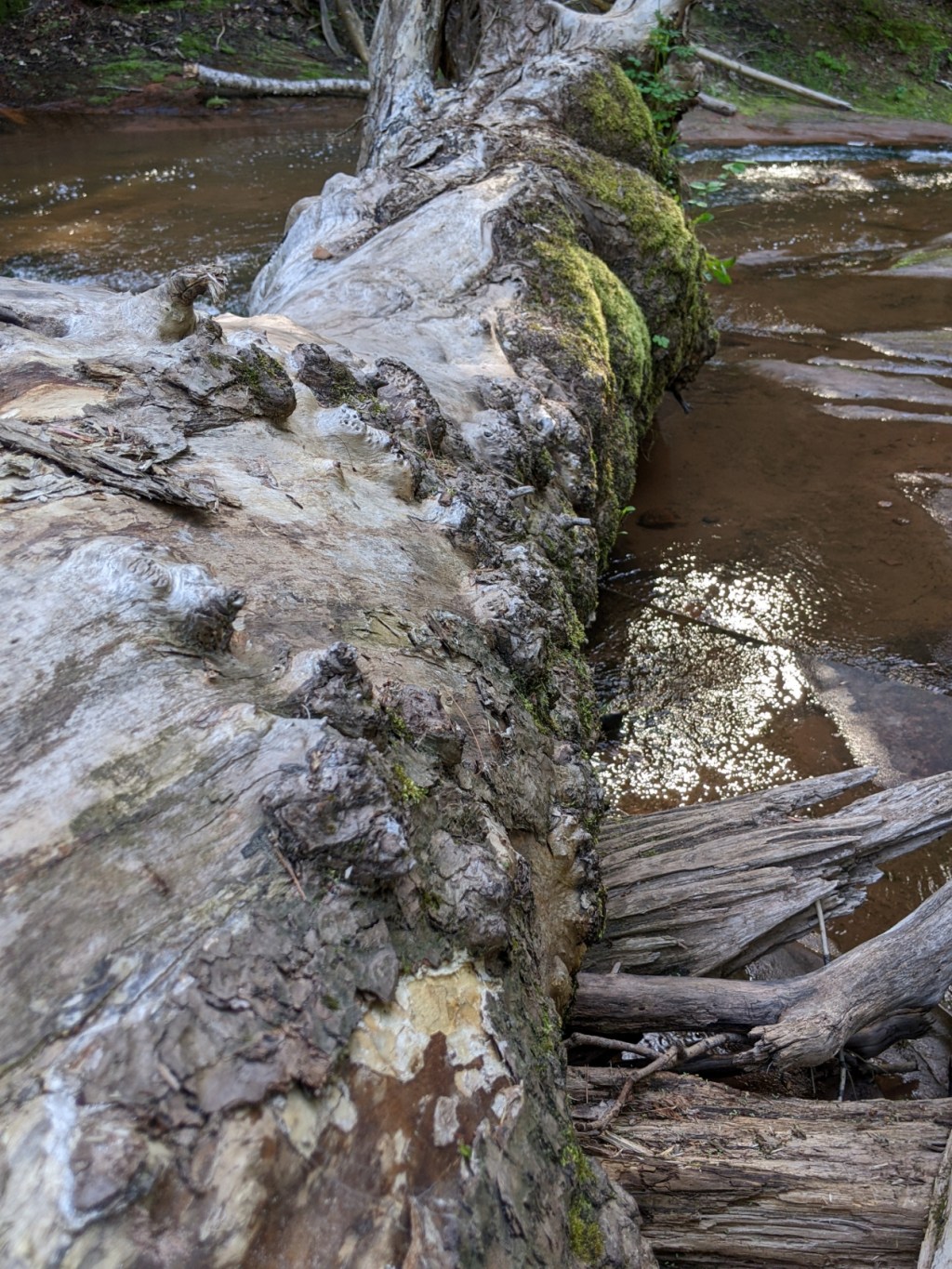
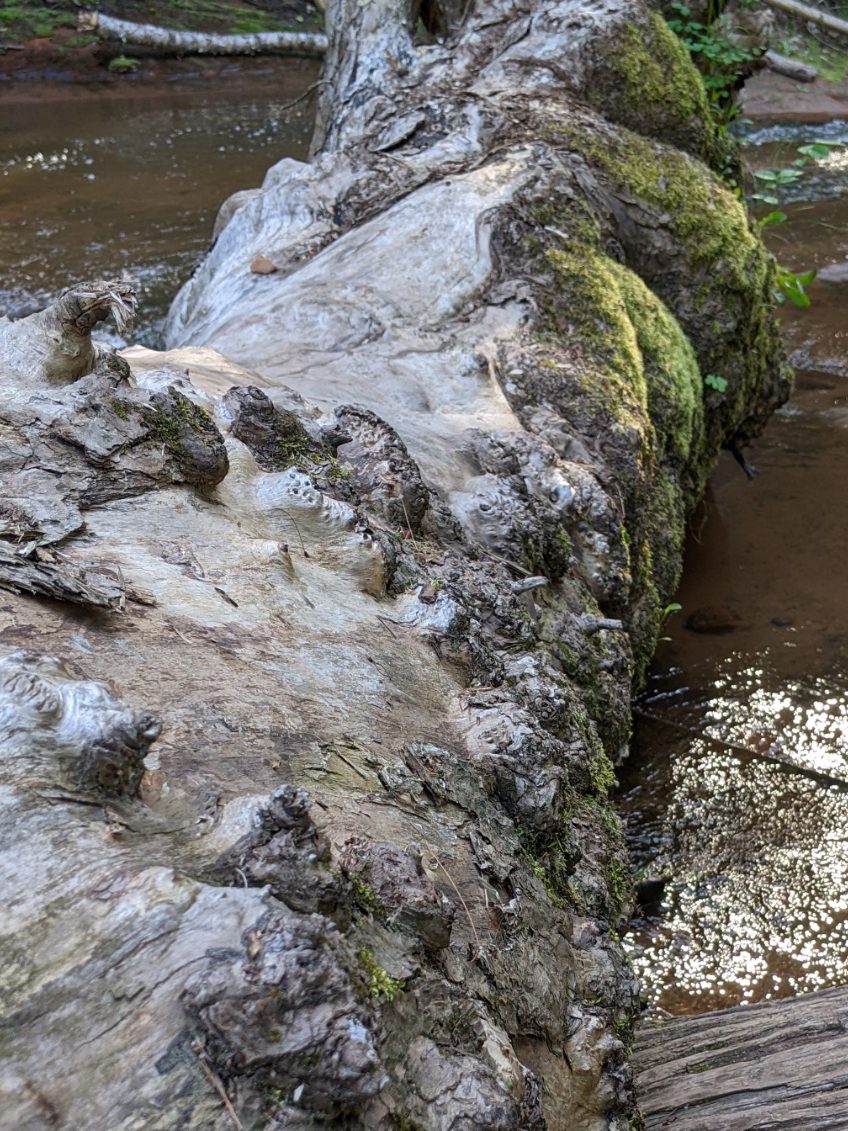
The habits of a naturalist are eternally ordinary. Watch, count, find wonder, and repeat endlessly (there is always an end, but let’s ignore that part for today). In walking with a friend at Siskiwit Falls today, in the tiny village of Cornucopia along Gitchi Gummi’s southern shore, I counted the steps one of the waterfalls had carved into the sandstone in one particular spot, 13, and compared it to another spot. All this counting before wandering down to a sandbar where a bare tree lies, a mystery to be identified and cataloged. And by cataloging we may know a little more or satisfy our inner curiosity, through which we naturalists build an honorable relationship with Place.
My friend and I debate the patterns of bark and growth, and find meaning in the speckling of knots along the debarked tree. We guess everything from alder to box elder to cottonwood. Through all this we find meaning from each other, deepening human bonds over curiosity in the slightest mystery. The habits of a naturalist are all about noticing relationships and tying niches together into a whole picture of a biome, large or small, and that includes human connections as well. My friend and I are just getting to know each other, and this mystery is our connection point. It is soon forgotten when they find an orchid along the river’s banks, a green bog orchid, which I still check in on every so often.
Along the same banks, we later observe layers of sandstone, separated from the main body of bedrock. Here on the South Shore our bedrock is glacial till and sandstone on top of igneous gneiss. Here in particular, the river has eaten a path in the sandstone, and along these banks’ underneath cedar roots and their threads of roots, disks of sandstone have fallen from the main body of bedrock, to be cradled aloft by the roots of the cedar. I feel that way sometimes. Separated from the beloved source, and held up by the barest of gossamer strings. Somedays, I feel as the debarked tree must, or as the sandstone steps of the waterfalls. Feeling deep relationship, kinship even, is also a habit of a good naturalist.

 Gossamer Naturalist